Something deep, dark and disturbing lurks in the collective consciousness of humanity.
Do you feel it? Your clients certainly do.
Your clients are deeply aware of social and geopolitical macrotrends. Really knowing what’s going on is essential to building substantial wealth. That’s why they entrusted your firm to preserve their assets. They needed your help to be one step ahead in an increasingly complex investment game.
And you’re failing them, because you’re not (personally) acknowledging the real financial risks to their portfolio in the face of societal collapse.
How much of what’s really going on in the world do you communicate to your clients?
Let’s be frank about what’s happening behind the mainstream cacophony that melodramatizes only meaningless microevents.
Three massive geopolitical megatrends are converging at breakneck speed, like unstoppable trains on a collision course.
- The rise of totalitarian regimes across the planet, even in previously free places like the UK, Europe, Canada, Australia, and the US. Totalitarianism often leads to social unrest, making your client feel unsafe in their homes and communities.
- A market meltdown and economic calamity caused by a tsunami of cheap money being pumped into the system in a desperate attempt to keep the wheels turning and the lights on. Although they may not talk about it, your clients are concerned about a possible failure of financial institutions, which could make it difficult for them to access their funds or other financial services.
- Accelerated degradation of the natural world, which has powered humanity’s phenomenal progress. This leads to concern that their grandchildren may not be able to access vital resources like clean water and arable land.
 In the face of these converging megarisks, your client awakes in the middle of the night in a cold sweat, screaming “WTF do I say to my granddaughter when she asks me on my deathbed what I did to stop <<risque du jour>>?!” (from a growing list of risks making up our meta-poly-crisis).
And as their wealth manager, you remain silent. You offer not a single plausible answer.
Because faced with massively increasing complexity you don’t know what to say.
These extraordinary times require – no, demand – that you better know what’s going on, way beyond the scope of your financial expertise.
The very foundations of the economic system that we’ve taken for granted are crumbling. Many of the structures that organised social and economic life while your client was building their wealth are either transforming or in some cases completely falling apart.
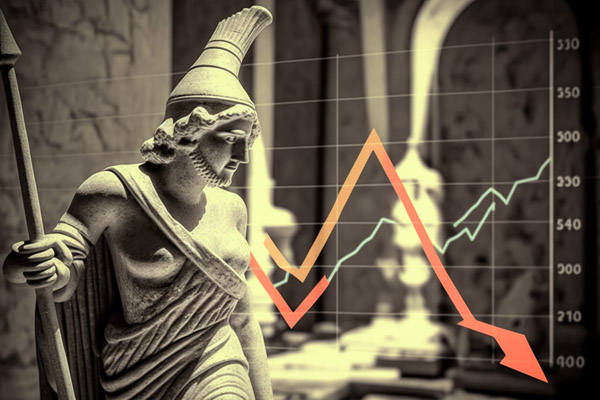
Why are you not keeping up with the exponentially accelerating changes?
“But, but, but,” I hear you splutter indignantly. “What empirical evidence do you have that our civilization is close to collapse? From where I sit, everything looks fine. You’re smoking your socks. My clients are perfectly OK.”
Good question. Fortunately someone has answered this question already, using data rather than opinion, and it’s not a pretty picture.
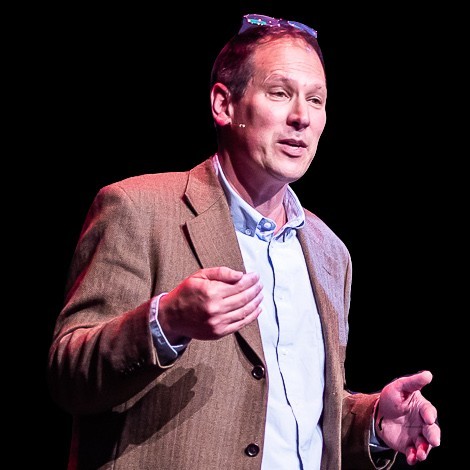
Peter Turchin is a scientist specializing in cultural evolution. He – and a team of professors from around the world – have built a massive database from 10,000 years of historical data. It was no small feat, because they had to convert ancient texts to machine readable text. But they felt that the effort was worthwhile, because without this data we cannot establish empirical, data-driven explanations for social patterns. The database is called Seshat, named after the Egyptian goddess of writing and measurement and the ruler of books.

Seshat is so good at trend-spotting based on historical data that it predicted the likes of Sam Bankman-Fried (FTX), Adam Neumann (WeWork), Elizabeth Holmes (Theranos), and even Markus Jooste (Steinhoff). It explains the collapse of companies like Enron, WorldCom, Lehman Brothers, Bear Stearns, and AIG within the context of a slow societal collapse.
The corporate promises aside, Seshat highlights an historical pattern. The pattern linking the disgraced business leaders of these failed companies is a claim that they had no awareness or control of internal systems. In other words, they didn’t know WTF was going on. The Seshat data has shown – time and again – that lack of resilience during a time of increasing complexity is a huuuuge red flag and predictor of collapse. “Lack of resilience” is another way of saying: “I don’t know WTF is going on… I’m overwhelmed by the speed at which sh*t is hitting the fan.”
Collapse always follows increasing complexity

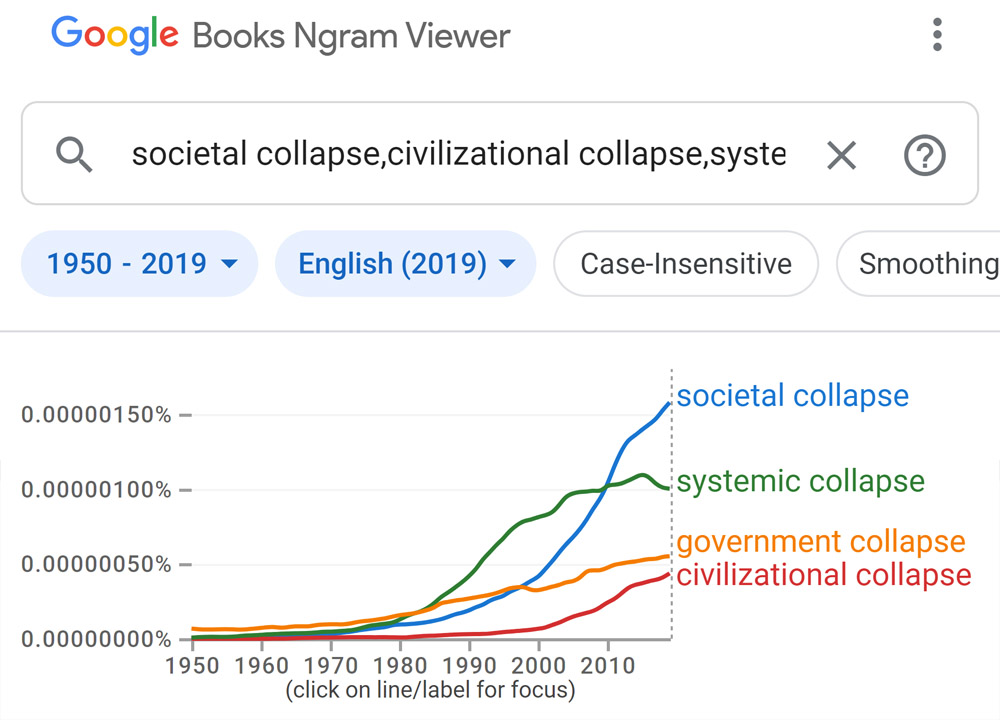
The collective excuses given by these founders – combined with the obviously increasingly fragile global supply system – is the clearest signal yet that collapse is imminent. The “climate change” debate is just a distraction from the elephant everyone is trying to ignore: complex systemic risks are swamping us.
You personally have noticed that things are getting really crazy, really quick. Just in our lifetime we’ve seen the dot-com boom and bust. Then it was robotics assembling Teslas and now AI is writing code and poetry and producing art. In the financial world, progress has been just as spectacular. BlackRock’s Aladdin platform now makes 250,000 automated trades… every single day. How many trades can YOUR FIRM make per day? Who can keep up with this astounding progress?
An unintended consequence of this breathtaking progress is, unfortunately, the wheels falling off. If we can learn anything from history, Turchin implores us to learn that collapse is an inevitable outcome of rapid progress. In other words, we must expect an increasing number of incredulous investment implosions through the remainder of this decade.
This catastrophic risk to your clients’ portfolios cannot be understated. (Oh, and don’t fool yourself that your clients are unaware that you are being forced to promote ESG-friendly investments rather than more profitable investments. They know, which is why their trust in you is plummeting.)
We don’t know when, but we do know turbulent times are coming
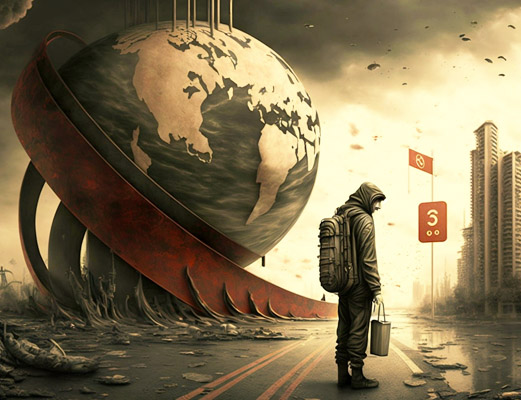
Turchin has warned – over and over again – that while an exact date cannot be predicted, the data shows that it’s highly likely that this very decade will see the worst geopolitical and socio-economic crisis in modern history.
But no-one has the time to wade through his extensive research. Everyone is much more focussed on current events than future events.
Except me.
You see, I’m a solo dad to a daughter who will turn 21 in 2035. Her future is all I think about. Her birth prompted me to search for alternatives to the unintended consequences of the stupendous success of capitalism.
As a result of what I’ve discovered, I’m hugely optimistic about the world my daughter will celebrate her 21st birthday in. That is, IF you and your clients act with wisdom, courage and determination.
What IS the way forward?

I’ve spent the past 15 years scouring the planet for solutions. I specifically searched for approaches that don’t replicate the unintended consequences of the extraordinarily beautiful system of trade, incentives and coordination that lifted billions out of poverty.
The good news is that there are thousands of creative responses to our economic, social and environmental challenges. But you, your clients and the rest of society don’t know about them. I know about them, only because I made it my life mission to find them, even when the going proved tough.
These bottom-up approaches are mind-blowing, but recognizing their value most often requires a very different level of thinking. It’s the level of thinking your clients crave, and can’t find anywhere. You could be the person who introduces them to a way of thinking about their legacy in entirely new ways, but you need a few pointers.
That’s where I can help. I’m not a financial advisor. I partner with exceptional advisors like you.
Let’s talk.